
Composing Quiet Hours
At Saunaday, I’ve always believed that communal bathing is more than heat, steam, water, and people. It’s about creating the conditions for presence, genuine care and connection. Our team teases me when I say things like this, but I truly believe this.
Earlier this year, in the dark of January, I put out a call for artists interested in creating work for the bathhouse. I had imagined visual installations—light, projection, moving images that might accompany the bathing ritual.
What I didn’t expect was a response from a local composer, Efrat Koppel.
The result is better than anything I could’ve imagined: a soundscape that is subtle yet transportive. It doesn’t demand attention, but gently shapes the atmosphere of the space.
If you have the chance, I highly recommend you experience our Composer-in-Residence Efrat Koppel’s work during our daily quiet hours from 7–10am through the end of April.
In honor of this work, I asked Efrat a few questions about composing for Saunaday.
-Roshelle
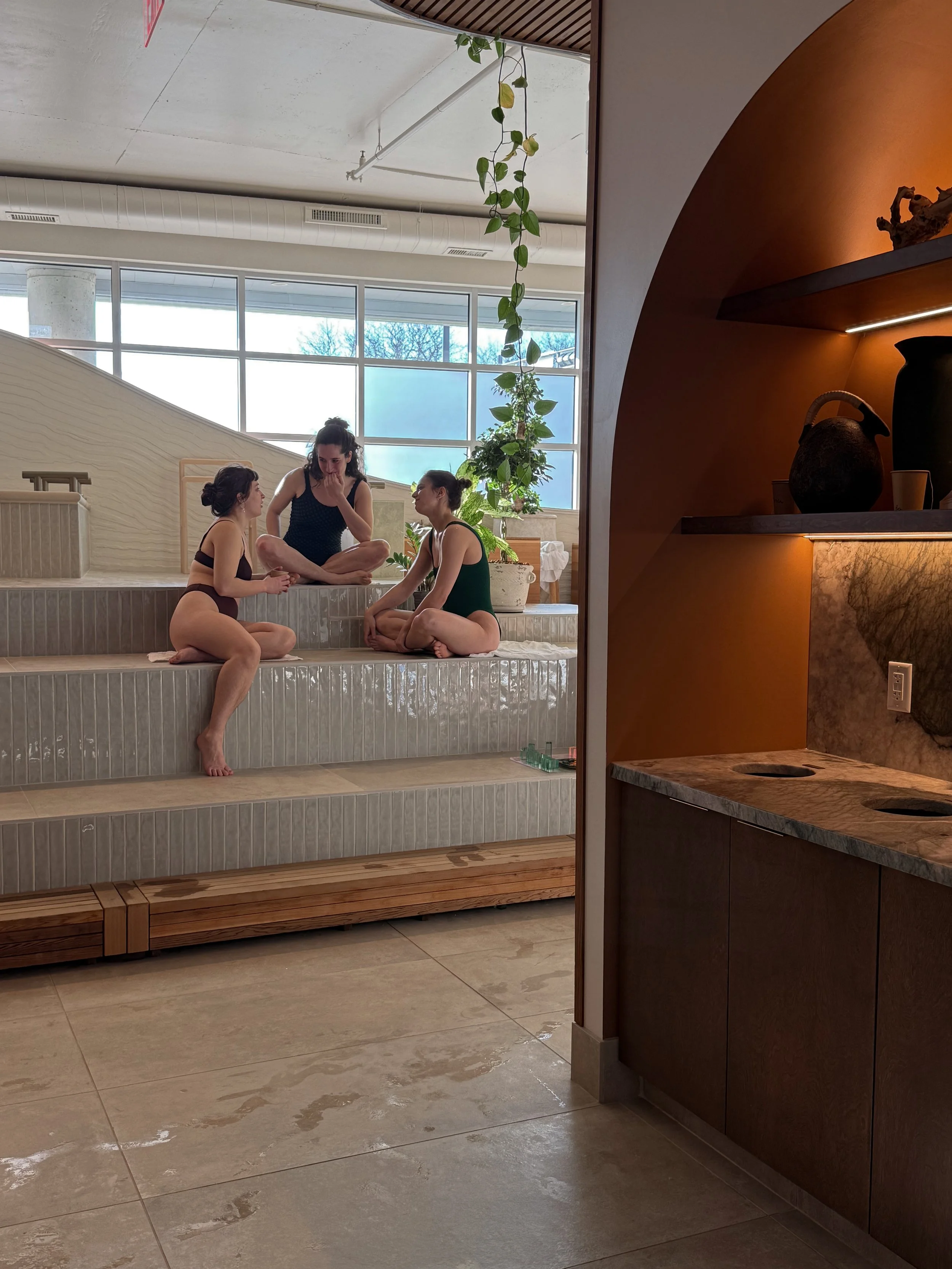
Efrat with guests during the morning opening
Interview with Efrat Koppel
What drew you to create work for a bathhouse?
Initially, I was drawn to the bathhouse first as a person not yet as a composer, gratefully, during a time I really needed it. I was navigating loss and change in my life, and felt the world beyond my control. I had never understood sauna and had little comfort with it, but I had this intuition that I really needed something that was there. Regaining a sense of control and autonomy in my body through sauna—through meeting intense heat, cold, the calm of the showers—was a salve I couldn’t even have dreamt of.
As a composer, I was then drawn by the experience of embodiment, transformation, and connection to pain through stillness and challenges. What I mean is that I knew something from my own lived experience of putting my body into new sensations, stretching, and feeling something new—all of these let feelings and processes unfold. Because I felt like I so intimately understood something that was transpiring there, I felt like I could compose for Saunaday, and I deeply wanted to offer my work to the place. I knew I could make music that would further that possibility of spaciousness, discovery, internal movement. Emotionally, I wanted to and felt I could make an audio atmosphere of peace and also of enough stillness. We have so much stimulation in our lives - weaving silence and slowness into sonic space is absolutely essential in a place like Saunaday. It reminds us that time is something that can bend, and is there actually to serve us.
What inspired your work for this residency? What elements of the Saunaday experience were you hoping to bring into the music?
Within the bathhouse, light, air, and water are the fundamental threads of my inspiration. Those elements are my cornerstone muses here for spaciousness and time, particularly as a result of how Saunaday is physically designed - the privacy of the place married to the windows letting us remember and stay in contact with the world outside. I’m inspired by how the movement of our bodies naturally changes around and within those elements.
I am also inspired by the myriad moments of intimacy I see play out there. Every time I go, I see pairings of friends, lovers, family members, and the way they explore that space together, the way they inhabit the time of that place together, is so moving.
Beyond the bathhouse, I’m tremendously inspired by nature, ever-changing underneath and around us. A few years ago, I learned that the traditional Japanese almanac counts 72 micro-seasons, each lasting 5 days, and I haven’t stopped thinking about it since. I haven’t stopped being inspired by the possibility of tuning into each moment, noticing and celebrating its preciousness.
For as long as I’ve been a composer, I’ve collected sound. I’m always collecting sound, these days every day. I love weaving in organic sound into my compositions - it adds a beauty that cannot be created with manmade instruments. Already in my work for Saunaday, I’ve added a repeating musical moment about 7 minutes long I recorded last month from a cave overlooking a valley blanketed by a storm. What was wild was I had dreamt the whole scene before I even knew I’d be traveling. The whole thing was surreal, and sounded gorgeous, so I sang there and included it as the opening, middle, and closing of the current Saunaday recording.
Speaking to the literal, the work of this residency is built around instruments and sound sources that evoke breath and spaciousness. I use voice. I bring in strings and some swelling synthesizers. I also use piano, my primary instrument and oldest relation as a composer. And there are keyboards and synthesizers that remind me of water droplets, or that sound like sitting beside a still body of water for a long time.
What do you hope guests listen for?
I wanna say that more than anything you can allow the music to serve you rather than listening for something within the music. Allow yourself to tune into what is arising.
That said, if you’d like to listen in with attention, listen for pace, stillness, how long it may take for a shift to occur, how long an idea may spend rooting and sending out its tendrils. It’s intentional. I designed the music to be more in line with how long someone may spend in a sauna— very different from the 3, 3.5 minute songs you may hear on streaming services or the radio. Listen for nature, the first musician of our world. Listen for sounds you’d recognize from your environments day to day. Do they sound more beautiful in this setting, where all you have to do is rest? I hope that my music can evoke awe and reverence, for all the sounds of our worlds and for our own timing.
Experience the Residency
Efrat Koppel’s original bathhouse soundscape can be experienced during Saunaday quiet hours, daily from 7–10am.